






1. Tile Guru Game Overview
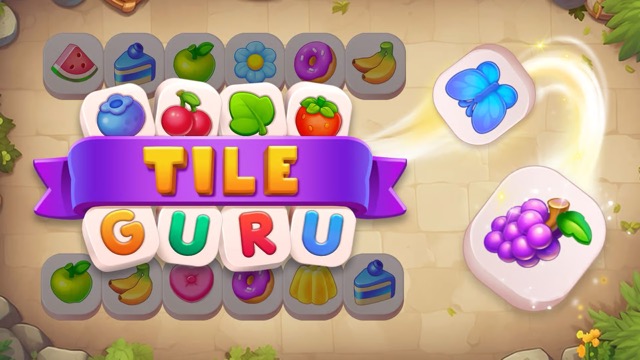
Tile Guru is a beautifully crafted 3D matching puzzle that blends the strategic depth of classic mahjong with the instant satisfaction of a match-3 game — wrapped in a charming garden aesthetic that makes every session feel like a peaceful, focused retreat. Stacked high with fruit, dessert, and snack tiles rendered in soft pastel tones, each level invites you to tap your way through layers of cheerful icons, collecting matching sets of three to clear the board before your tray fills up.
The core mechanic is deceptively simple: tap a visible tile to move it into your tray below, match three identical tiles in the tray to clear them, and keep going until the board is clear. But the layered stacking of tiles introduces a satisfying puzzle dimension that elevates Tile Guru well beyond a casual tap-fest. Tiles buried beneath others can't be selected until the layers above them are cleared — meaning every tap decision affects which tiles you can access next, and a sequence of poorly considered choices can bury exactly the tile you need under several more that can't be removed yet.
The result is a puzzle that rewards forward thinking and memory in equal measure: keeping track of what's buried, predicting what will surface as you clear, and sequencing your taps to avoid filling the tray with mismatched tiles you can't immediately clear. It's the kind of brain engagement that feels productive rather than stressful — the mental equivalent of a gentle stretch rather than a hard sprint.
With a calming garden setting, soft ambient music, daily rewards, and a gradual difficulty curve that never rushes you, Tile Guru has earned its reputation as the ideal short-session puzzle for players who want genuine mental engagement without the pressure of timers or punishing fail states.
Key Details:
- Genre: Matching Puzzle / Casual / Mahjong-Style
- Difficulty Level: Easy to Medium (deepens with layer complexity and tray management)
- Average Play Time: 5–15 minutes per session
- Best For: Fans of mahjong and match-3 puzzles, casual players seeking relaxing but mentally engaging games, anyone who enjoys beautifully illustrated food and nature themes
How to Play Tile Guru
Getting Started:
1. Study the tile stack at the start of each level — observe which tiles are visible (accessible) and which are hidden beneath others.
2. Tap any visible tile to move it into the tray at the bottom of the screen.
3. When three identical tiles accumulate in the tray, they automatically clear — earning points and freeing tray space for more tiles.
4. Continue tapping tiles strategically, managing your tray to avoid it filling with too many non-matching tiles simultaneously.
5. Clear all tiles from the board to complete the level and progress to the next, more complex stage.
Basic Controls:
- Tap / Click on Visible Tile — move it into the tray below
- Tray — holds up to a limited number of tiles awaiting matches; fills from left to right
Objective:
Clear every tile from the board by collecting matching sets of three into the tray. Balance tile selection carefully to keep the tray from filling with unmatched tiles — a full tray before a match is completed ends the round. Complete all tiles to finish the level and unlock the next stage.
Tile Guru Features & Highlights
- Mahjong-Meets-Match-3 Mechanics — A uniquely satisfying hybrid that combines the layered tile access logic of mahjong with the instant-clear satisfaction of matching three identical items into a tray
- Food and Nature Tile Design — Dozens of beautifully illustrated fruit, dessert, and snack tiles rendered in pastel tones — apples, grapes, donuts, clovers, and more — create a consistently cheerful and visually refreshing puzzle environment
- Layered Tile Architecture — Tiles stacked in multiple layers create genuine strategic depth, as accessing buried tiles requires thoughtful sequencing of which surface tiles to remove first
- Gradual Difficulty Progression — New levels introduce additional layers, more tile varieties, and more complex stacking arrangements without ever introducing time pressure, keeping the challenge gentle but consistently engaging
- Daily Rewards & Power-Ups — Daily login bonuses and bonus puzzle rewards provide coins to unlock hints and power-ups, supporting a gentle progression system that rewards regular play
Tile Guru Tips & Strategies
Beginner Tips:
- Scan the full board before your first tap: Before touching anything, identify which tiles appear most frequently on the surface and which matching sets are most accessible. A quick scan reveals obvious three-tile matches waiting to happen and helps avoid early tray congestion.
- Prioritize tiles that unlock buried matches: Surface tiles sitting directly on top of two other matching tiles are the most valuable to clear first — removing them surfaces a matching pair and potentially enables an immediate triple match from the next available tile of that type.
- Never let the tray fill with five or more unmatched tile types: The tray has limited capacity, and filling it with many different tile types before clearing any of them severely limits your next moves. Aim to keep no more than three or four different tile types in the tray at any time.
Advanced Strategies:
- Track buried tile locations mentally as you play: As you clear surface tiles, note what you're revealing beneath them. Keeping a rough mental map of where specific buried tiles are located lets you plan several taps ahead — clearing surface tiles in the order that surfaces the tiles you need most, rather than reacting tile by tile.
- Build toward triple matches before collecting the third tile: If two identical tiles are already in your tray, prioritize finding and tapping the third matching tile before adding more unrelated tiles — a match in progress is your most urgent priority, as it clears two tray slots immediately.
- Use power-ups and hints proactively on complex layouts: Hints and power-ups are most valuable when used before you're stuck, not after. Identifying a level arrangement that's heading toward a deadlock early and using a hint or power-up to break it costs fewer resources than waiting until the tray is nearly full with no matches available.
What to Watch Out For:
- Tapping tiles without a clear tray plan: Each tile you add to the tray without a matching pair already there occupies a slot that a more useful tile could have filled. Before tapping, ask whether the tile you're about to collect brings you closer to a match or simply congests your tray.
- Ignoring deeply buried tiles until it's too late: Tiles at the very bottom of deep stacks are the hardest to access and often hold the tile types that become bottlenecks late in a level. Periodically making progress toward uncovering deep tiles — even at the cost of some immediate matching efficiency — prevents late-level situations where you need one specific tile that's still buried under several others.
Tile Guru Game Elements Explained
Tile Selection & Layered Access System
The layered tile access system is the strategic engine that elevates Tile Guru above simple matching games into genuine puzzle territory. At the start of each level, tiles are arranged in a multi-layer stack — some fully visible and immediately tappable, others partially or fully hidden beneath tiles that must be cleared first. The accessibility rule is simple: a tile can only be selected if no other tile is resting on top of it. But the strategic implications of this rule are substantial. Because the order in which you clear surface tiles directly determines which tiles surface next, every tap is implicitly a decision about future access — and sequences of decisions that seem locally optimal can lead to globally suboptimal board states where the tiles you need are buried under ones you can't currently clear. Developing the ability to think two, three, or four taps ahead — visualizing how the board's topography will shift with each removal — is the core skill that separates players who consistently clear boards cleanly from those who regularly run into tray-full stalemates with critical tiles still buried.
Tray Management & Match Mechanics
The tray is Tile Guru's most consequential constraint and the source of its primary strategic tension. Functioning as a limited holding area between tile selection and match completion, the tray accumulates tiles until three identical ones are present — at which point they automatically clear, freeing those slots for new tiles. The strategic challenge is managing the tray's capacity across an entire level: consistently adding tiles that advance existing matches while avoiding accumulation of too many non-matching types that congest available slots. A well-managed tray stays in a state of continuous throughput — tiles arriving, matching, clearing, and making room for the next batch in a smooth cycle. A poorly managed tray fills with mismatched tile types, eliminates all flexibility for new additions, and eventually reaches a full state that ends the round. The skill of tray management is closely linked to the tile selection strategy described above: choosing which surface tile to tap at each moment is inseparable from knowing what that choice will do to the tray's composition over the next several moves.
Progression, Daily Rewards & Power-Ups
Tile Guru's progression and reward systems are designed around the philosophy of gentle encouragement rather than aggressive monetization pressure. Each level cleared advances you to the next stage, which introduces more complex tile arrangements — additional layers, more diverse tile types, and more intricate stacking patterns — that require corresponding growth in strategic sophistication to navigate. The difficulty curve is calibrated to feel consistently engaging without ever becoming overwhelming or requiring a sudden leap in skill. Daily login rewards provide coins at a steady pace that accumulates meaningfully for players who check in regularly, and bonus puzzle rewards supplement this with additional earning opportunities beyond the main level progression. These coins unlock hints — which recommend a specific next tap when you're genuinely stuck — and power-ups that address specific types of board difficulty, such as clearing a random tile from the tray or temporarily extending the tray's capacity. The power-up system's restraint is notable: it provides genuine assistance without trivializing the puzzle, ensuring that cleared levels always feel earned by the player's own thinking rather than tool use.
Tile Guru FAQ
Q: How do I select tiles in Tile Guru?
A: Tap or click on any tile that is fully visible — not covered by another tile resting on top of it. The selected tile moves automatically into the tray at the bottom of the screen. If a tile doesn't respond to your tap, it's still covered by at least one other tile that must be removed first. Work from the top layer downward to progressively reveal buried tiles.
Q: What happens if my tray fills up before I complete a match?
A: If the tray reaches its maximum capacity without a set of three matching tiles clearing it, the round ends. To avoid this, always monitor your tray composition as you play — if you notice several different tile types accumulating without matches, prioritize finding and tapping tiles that complete existing pairs before adding more new types. Using a hint or power-up before the tray is completely full is more effective than waiting until it's already too late.
Q: How do I access tiles that are buried beneath others?
A: Buried tiles become accessible by clearing the tiles resting on top of them. Tap the surface tiles covering a buried tile you need, and once all tiles above it are removed, it becomes selectable. Planning which surface tiles to remove in what order — to surface specific buried tiles at the right moment — is the core strategic skill of Tile Guru's layered puzzle design.
Q: How do daily rewards and coins work in Tile Guru?
A: Daily rewards are earned by logging into the game each day — each consecutive login provides coins that accumulate toward purchasing hints and power-ups. Bonus puzzle challenges provide additional coin-earning opportunities beyond the main level progression. Coins are spent in the power-up and hint menu during gameplay, with each use costing a specific coin amount. Consistent daily logins and bonus puzzle participation are the most reliable way to maintain a healthy coin balance for difficult levels.
Q: Is Tile Guru suitable for short play sessions?
A: Tile Guru is specifically designed for short, satisfying sessions — most levels are completable in five to ten minutes, and the no-timer design means you can pause your thinking at any moment without penalty. The calming garden aesthetic, soft ambient music, and gentle difficulty curve make it an ideal brief mental reset during a busy day. Daily rewards further reinforce the short-session rhythm, giving each login a natural starting point and a sense of daily progression even without extended play time.
Games Like Tile Guru
If you like Tile Guru, you might also enjoy:
- Water Sort - It shares the limited-space puzzle pressure where sequencing mistakes can lock the board.
- Microsoft Jewel 2 - It offers another tile-focused puzzle loop with satisfying clears and chain potential.
- Brain Test - It keeps the casual puzzle energy while changing the challenge to lateral thinking.