







1. Lines To Fill Game Overview
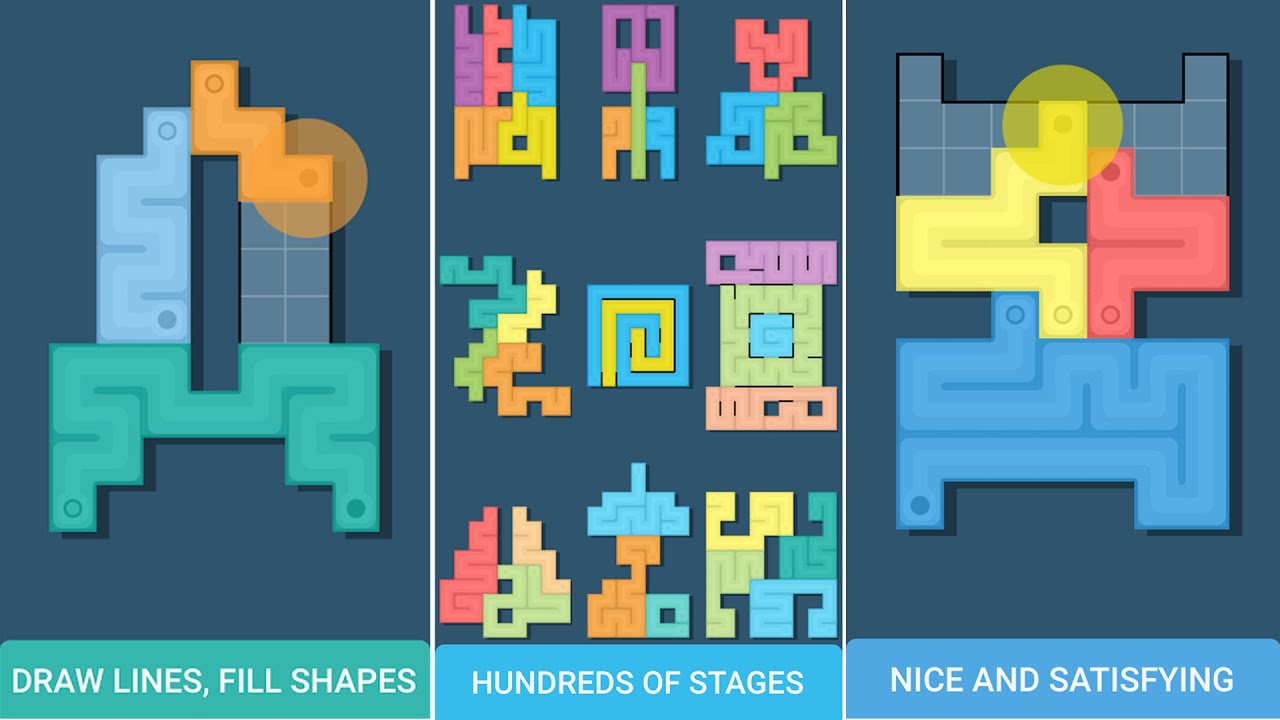
Lines to Fill is a clean, thoughtful block-fitting puzzle game that challenges you to fill a board completely using a set of colorful, pre-shaped pieces — no gaps, no overlaps, no going out of bounds. Each level presents a specific arrangement of pieces that must be placed in exactly the right configuration to tile the board perfectly, turning what looks like a simple spatial task into a genuinely engaging exercise in shape analysis, positional reasoning, and step-by-step planning.
The game's structure is elegantly layered: each main level contains several sub-levels that must be completed in sequence, creating a natural pacing rhythm that introduces new spatial challenges progressively without overwhelming new players. Early levels function almost as gentle tutorials — small boards, straightforward shapes, partial arrangement suggestions built into the design — before giving way to significantly more demanding configurations where blocks are irregular, arrangements are non-obvious, and the consequence of a single misplaced piece is having to restart entirely.
That restart condition is the game's most honest design choice. Unlike puzzle games with undo buttons or step-back mechanics, Lines to Fill commits fully to its spatial logic: if you place a piece in the wrong spot before recognizing the error, you start over. This isn't punishing — it's clarifying. Each restart comes with the knowledge of exactly why the previous approach failed, turning errors into efficient learning rather than frustrating dead ends.
The no-rotation rule amplifies this honest difficulty. Every piece must be placed in the exact orientation shown — there's no rotation-based workaround available. What you see is exactly what you're working with, making spatial visualization of each piece's shape the primary skill the game develops and rewards.
Key Details:
- Genre: Block Fitting Puzzle / Spatial Strategy / Casual
- Difficulty Level: Easy to Hard (progressively within each level set)
- Average Play Time: 10–20 minutes per session
- Best For: Fans of spatial puzzles and fitting games, players who enjoy methodical problem-solving without time pressure, anyone who appreciates clean puzzle design with honest difficulty escalation
How to Play Lines To Fill
Getting Started:
1. Study the board shape and the available pieces for the current level — note each piece's exact shape and size before touching anything.
2. Identify which piece is most constrained in where it can be placed — pieces with unusual shapes often have only one or two valid positions.
3. Hold the left mouse button on a piece in the selection area, drag it to your chosen position on the board, and release to place it.
4. Continue placing remaining pieces, working from most-constrained to least-constrained shapes to maximize your placement flexibility.
5. Complete the sub-level by filling every cell of the board exactly — no gaps, no overlaps — then advance to the next sub-level within the main level.
Basic Controls:
- Hold Left Mouse Button + Drag — pick up a piece from the selection area
- Drag onto Board — position the piece over the intended cells
- Release Mouse Button — place the piece in the current position
*Note: Pieces cannot be rotated. Each must be placed in its exact presented orientation. Placement is final — pieces cannot be moved after being placed.*
Objective:
Fill every cell of the board using all provided pieces with no gaps, overlaps, or out-of-bounds placements. Complete each sub-level within the main level, then advance to the next level featuring new board shapes and piece configurations. Progress through escalating difficulty, from simple introductory arrangements to complex multi-piece configurations that require careful advance planning.
Lines To Fill Features & Highlights
- No-Rotation Fixed Placement — Every piece must be placed in its exact presented orientation, making shape visualization and precise spatial reasoning the core skill the game develops
- Sub-Level Progression Structure — Each main level contains multiple sub-levels completed in sequence, creating a natural pacing rhythm that introduces spatial complexity gradually without abrupt difficulty jumps
- Honest Restart-on-Error Design — Incorrect placements require restarting the level, making each attempt a focused learning experience that builds genuine spatial intuition over repeated play
- Progressive Complexity Curve — Levels transition smoothly from small, simply shaped introductory boards to large, densely complex configurations with irregular pieces requiring multi-step advance planning
- Clean, Distraction-Free Design — A focused visual aesthetic with colorful piece differentiation and clear board boundaries keeps attention on the spatial challenge without unnecessary visual clutter
Lines To Fill Tips & Strategies
Beginner Tips:
- Identify your most constrained piece first: Before placing anything, find the piece in your set with the fewest valid positions on the board — irregular shapes, large pieces, or pieces with unusual notches almost always have only one or two places they can legally go. Place these first while the board is fully open.
- Work from the edges inward: The board's boundary creates natural constraints for pieces that include edge-adjacent cells. Positioning pieces that touch the board's perimeter first establishes a stable framework and makes filling the interior significantly more tractable.
- Mentally place every piece before physically placing any: Especially in more complex levels, doing a full mental dry run of the placement sequence — placing piece A here, then piece B there, checking that piece C still fits — identifies sequencing errors before they require a restart.
Advanced Strategies:
- Treat each sub-level as independent spatial practice: Sub-levels within a main level often share piece types but with different board arrangements. Solving earlier sub-levels builds pattern recognition for the shapes in later ones — pay attention to how each piece fits differently in different board configurations.
- Look for the piece that divides the board into two separate regions: On complex levels, a single key piece placed incorrectly can divide the remaining board space into two disconnected regions that the remaining pieces can't collectively fill. Identify which piece would cause this separation and ensure it's placed in a way that maintains a single connected fill-space.
- Use color differentiation to track remaining pieces: Each piece in Lines to Fill is distinctly colored, making it easy to cross-reference the remaining pieces against the remaining board space. When only two or three pieces remain, visualizing which colored pieces go where becomes significantly more tractable — use the color coding to lock down the most visually obvious remaining placements first.
What to Watch Out For:
- Placing a piece that creates an isolated gap: A cell surrounded on all sides by filled cells or board boundaries that doesn't match any remaining piece's shape makes level completion impossible. Before placing each piece, check whether the remaining open space will still be fillable by your remaining pieces — isolated single-cell or oddly shaped gaps are the most common restart trigger.
- Over-relying on trial-and-error rather than visualization: Restarting is a legitimate part of Lines to Fill's design, but restarting repeatedly with the same approach each time isn't productive. Each restart should come with a specific insight about why the previous attempt failed and a concrete change to your placement sequence — purposeful restarting builds spatial skill; random restarting doesn't.
Lines To Fill Game Elements Explained
Piece Fitting & Board Coverage System
The piece fitting system is the complete puzzle challenge of Lines to Fill, and its rules are deliberately minimal: place every piece on the board without gaps, overlaps, or out-of-bounds cells, and the level is complete. No rotation is permitted — pieces must be placed in the exact orientation presented. No undo is available — once a piece is placed, it stays. This austerity is what makes the game's puzzle design work: the challenge comes entirely from the spatial reasoning required to determine the correct placement sequence for a given set of pieces on a given board, not from mechanical complexity or time pressure. The board configurations vary significantly between levels — some boards are simple rectangles, others are L-shaped, T-shaped, or more irregular outlines that create asymmetric filling challenges requiring correspondingly asymmetric piece arrangements. Each board's specific shape, combined with its specific piece set, creates a unique fitting puzzle with a solution that rewards methodical analysis over random experimentation, even though random experimentation is always permitted as a learning strategy.
Sub-Level Progression & Difficulty Architecture
The sub-level structure is Lines to Fill's most thoughtful design feature, creating a difficulty architecture that feels genuinely graduated rather than arbitrarily spiky. Each main level functions as a thematic unit containing several sub-levels that share a piece family or board shape category but vary in specific arrangement complexity. The first sub-level of any main level is designed to be accessible — a straightforward introduction to the piece types and board shape being practiced — while later sub-levels in the same set present those same elements in progressively more demanding configurations. This graduated approach means that solving a difficult late sub-level draws on pattern recognition built from the earlier, simpler sub-levels in the same set — players aren't encountering entirely unfamiliar shapes, just more demanding arrangements of shapes they've already begun to develop intuition for. The transition between main levels introduces genuinely new piece types, board shapes, or complexity categories, providing fresh challenge without abandoning the spatial vocabulary developed in previous levels.
Spatial Visualization & Learning-Through-Restart Design
Lines to Fill's no-undo, restart-on-error design is a deliberate pedagogical choice that distinguishes it from more forgiving puzzle games — and makes it more effective at developing genuine spatial reasoning skills. When a misplaced piece makes completion impossible, the restart prompt isn't a failure state; it's a feedback signal that a specific placement decision was incorrect, delivered with complete information about which decision it was and what consequence it created. Players who approach each restart as a data point — "piece B can't go in the top-left because it creates an isolated gap in the corner" — build spatial intuition progressively across attempts, developing the visualization skills that allow later levels to be solved in fewer attempts. The no-rotation rule amplifies this learning dynamic: because pieces can't be rotated to fit differently, every placement is a pure test of whether you correctly visualized that piece's exact shape fitting into that exact board position. Developing the ability to mentally rotate and test piece fits before physically placing them — without the crutch of actual rotation as a fallback — is the core cognitive skill Lines to Fill builds most directly and most effectively.
Lines To Fill FAQ
Q: How do I place pieces in Lines to Fill?
A: Hold the left mouse button on any piece in the selection area, drag it over the board to the position where you want to place it, and release the mouse button to lock it in. The piece will snap into the grid cells it's positioned over. If the placement is invalid — overlapping another piece, extending beyond the board boundary, or covering already-filled cells — the piece will return to the selection area rather than placing.
Q: Can I move a piece after placing it?
A: No — once a piece is placed on the board, it cannot be moved or repositioned. If a placed piece is making the level completion impossible, you must restart the entire level and approach the placement sequence differently. This permanent placement rule is central to the game's design — it makes each placement decision meaningful and encourages thorough analysis before committing any piece to its position.
Q: What should I do if I can't figure out where a piece goes?
A: First, identify which cells remain unfilled and compare their total count and configuration to the pieces you haven't placed yet — the numbers should match exactly. Then identify the most constrained remaining piece — the one with the fewest valid positions given the current board state — and focus on placing that one next. If multiple attempts haven't revealed the solution, restart the level and try beginning with a completely different piece than you started with before — sometimes the first placement determines whether the rest of the sequence is solvable.
Q: Why can't I rotate pieces in Lines to Fill?
A: Lines to Fill's no-rotation rule is a deliberate design choice that makes the game's spatial challenge more precise and skill-building. Allowing rotation would provide a workaround that reduces the need for accurate shape visualization — with rotation available, almost any piece can be made to fit in multiple positions through trial and error. Without rotation, players must correctly identify a piece's exact orientation and how it maps to available board space, developing genuine spatial reasoning rather than rotation-aided trial and error.
Q: How do the sub-levels within each main level work?
A: Each main level contains a sequence of sub-levels that must be completed in order. Each sub-level presents a specific board configuration and piece set that must be perfectly filled. Completing a sub-level automatically advances you to the next one within the main level. After all sub-levels in a main level are complete, the next main level unlocks with a new set of board shapes and piece configurations. Sub-levels within the same main level typically share piece types but present increasingly complex fitting arrangements, building familiarity with those pieces before introducing entirely new shapes in subsequent main levels.
Games Like Lines To Fill
If you like Lines To Fill, you might also enjoy:
- Tiny Boxes - It shares the compact logic-puzzle feel where blocked space matters.
- Happy Glass - It also rewards planning the solution before making the decisive move.
- Hexa Puzzle - It offers another limited-board puzzle where shape and route coverage are key.