







1. Hexa Puzzle Game Overview
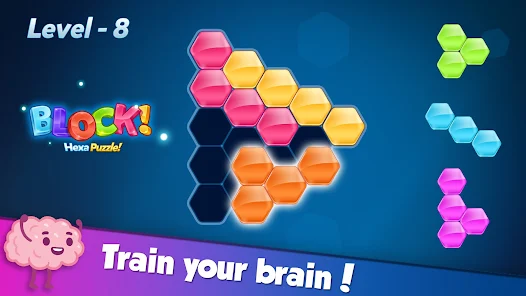
Hexa Puzzle is a visually striking and strategically satisfying hexagon block puzzle that challenges you to think in six directions at once. On a distinctive 19-cell honeycomb board, your task is to fit a set of hexagonal piece shapes together so cleanly that no gaps remain — and when you succeed, the entire arrangement vanishes in a satisfying chain reaction that clears the board and propels you to the next level.
The hexagonal grid is what sets Hexa Puzzle apart from every rectangular block puzzle that came before it. Where square-grid puzzles offer four directions of alignment, hexagons open up an entirely new geometric vocabulary: pieces interlock at angles that feel unfamiliar at first and deeply intuitive once mastered. The shapes feel fresh, the fitting logic feels rewarding, and the visual clarity of a perfectly completed honeycomb arrangement has a distinctive appeal that rectangular block puzzles simply can't replicate.
The game's design philosophy balances accessibility with depth. The core rule — fill the board completely without gaps — is immediately understandable. But executing that rule with the specific pieces you're given, in the right order, without painting yourself into a corner on the final placement, requires genuine spatial reasoning that grows more challenging as levels progress and piece combinations become more complex. Multi-layered color blocks add further tactical richness, and the combo reactions triggered by well-sequenced completions deliver the kind of cascading visual payoff that makes puzzle games genuinely addictive.
A thoughtful set of power-ups ensures you're never permanently stuck, while the no-timer design invites the careful deliberation that produces the most satisfying solutions.
Key Details:
- Genre: Hexagon Block Puzzle / Strategy / Casual
- Difficulty Level: Easy to Hard (escalates naturally with piece complexity)
- Average Play Time: 10–25 minutes per session
- Best For: Fans of spatial block puzzles, players who enjoy geometric thinking and precise fitting challenges, anyone looking for a visually distinctive puzzle experience beyond standard grid games
How to Play Hexa Puzzle
Getting Started:
1. Study the 19-cell hexagonal board and the set of piece shapes available to you below the board.
2. Select a hexagonal piece and drag it onto the board — position it carefully to fill gaps without creating isolated empty cells.
3. Continue placing pieces in an order that keeps your fitting options open, working toward a complete board with no gaps remaining.
4. When all pieces are placed and the board is fully filled, the blocks disappear in a satisfying chain reaction and the level is complete.
5. If a piece is placed incorrectly before the final placement, drag it to a better position — but note that once the last piece locks in, no further repositioning is possible.
Basic Controls:
- Click and Drag Piece — pick up a hexagonal piece from the selection area
- Drag onto Board — position the piece on the hexagonal grid
- Drag to Reposition — move a placed piece to a different position (only before the final piece is placed)
- Click on Power-Up Icons — activate support tools when stuck
Objective:
Fill every cell of the 19-cell hexagonal board with the provided pieces, leaving no gaps, to complete each level. Piece placement order matters — plan your sequence to ensure the final piece fits cleanly and the board is fully covered. Combo chain reactions reward efficient level completion with satisfying visual effects and progression to the next challenge.
Hexa Puzzle Features & Highlights
- Unique Hexagonal Grid — A 19-cell honeycomb board creates a geometrically distinctive puzzle space that feels genuinely fresh compared to standard rectangular block games, with six-directional fitting logic that rewards spatial thinking in new ways
- No-Gap Completion Mechanic — The requirement to fill the board completely without any empty cells creates a precise fitting challenge where piece order and placement sequence matter as much as individual piece positioning
- Multi-Layered Color Block System — Colored layers add tactical depth beyond simple fitting, requiring players to consider both spatial arrangement and color-clearing sequences for maximum combo potential
- Four Strategic Power-Ups — Remove any piece, swap two pieces, accelerate color layer removal, or gain additional move opportunities — each tool addresses a specific type of board difficulty without trivializing the core puzzle challenge
- Consecutive Combo Reactions — Well-sequenced placements trigger chain reactions that clear multiple sections simultaneously, delivering visually rewarding cascades that make efficient solutions feel spectacular
Hexa Puzzle Tips & Strategies
Beginner Tips:
- Start with your largest pieces: Large hexagonal pieces have fewer valid placement positions on the board than small ones — placing them first while the board is open gives you the most flexibility. Saving large pieces for last frequently results in no valid position remaining.
- Work inward from the edges: The curved edges of the hexagonal board create natural constraints for irregular pieces. Positioning edge-adjacent pieces first establishes a stable framework that makes filling the center significantly easier than working outward from the middle.
- Visualize the final piece before placing the second-to-last: The most common failure mode in Hexa Puzzle is placing the second-to-last piece in a way that makes the last piece impossible to fit. Before committing your second-to-last placement, check that the remaining gap exactly matches the remaining piece's shape.
Advanced Strategies:
- Plan your full placement sequence before touching any piece: On more complex levels, mentally working through the entire sequence — piece one here, piece two there, piece three completes this section — before making any physical placement prevents the mid-level discovery that an early choice has made completion impossible.
- Use the swap power-up to correct sequencing errors, not positioning ones: The swap power-up is most valuable when two pieces are each in the right general area but in each other's slots — a sequencing error. Using it to reposition a piece that's simply in the wrong location is better addressed by the remove power-up, which costs fewer resources for single-piece corrections.
- Target multi-layered color blocks early in the sequence: Color layers that require multiple placements to clear are the board's most demanding elements — addressing them early, while the board is open and you have maximum flexibility, is almost always more efficient than leaving them for late-game when your placement options are constrained.
What to Watch Out For:
- Creating isolated single-cell gaps: A lone empty hexagonal cell surrounded by filled ones on all six sides can only be filled by a single-cell piece — if no single-cell piece remains in your set, that gap makes level completion impossible. Scan regularly for forming isolated gaps and address them before they become permanent obstacles.
- Placing the final piece without checking all six edges: Because hexagonal cells have six neighbors rather than four, it's easier to misjudge whether a piece truly fits without gaps at every edge. Before placing your final piece, confirm every edge of its shape aligns flush with adjacent cells or the board boundary, with no partial overlaps or micro-gaps.
Hexa Puzzle Game Elements Explained
Hexagonal Grid & Fitting System
The hexagonal grid is the feature that most fundamentally distinguishes Hexa Puzzle from the crowded block puzzle genre and gives it a genuinely unique strategic identity. The 19-cell honeycomb layout means every cell has up to six neighboring cells rather than the four of a square grid, creating a richer set of adjacency relationships that both expand the fitting possibilities for each piece and create more complex gap patterns when pieces are placed suboptimally. Hexagonal pieces themselves come in shapes that simply don't exist in square-grid puzzles — curved clusters, arrow-like points, and branching forms that require a new spatial vocabulary to work with comfortably. The no-gap completion requirement is the mechanic that makes this spatial vocabulary worth developing: unlike puzzles that reward partial completions or high scores from imperfect arrangements, Hexa Puzzle demands perfect coverage — every one of the 19 cells filled, no exceptions. This precision requirement is what makes the sequencing of piece placements the game's central strategic challenge, since a perfectly valid-looking intermediate board state can still lead to an impossible final placement if the sequence wasn't planned correctly from the start.
Color Layer System & Combo Mechanics
The color layer system adds a tactical dimension to Hexa Puzzle that goes beyond spatial fitting into sequencing strategy. Multi-layered color blocks occupy cells that must have their color layers cleared before they can be considered fully filled — and clearing those layers requires specific placement interactions that vary by the type and depth of the coloring involved. The faster color layer removal power-up addresses situations where deep color layers threaten to bottleneck your completion sequence, instantly breaking through multiple layers and revealing the underlying cells for normal placement. Consecutive combos — triggered when well-sequenced placements clear multiple sections of the board simultaneously — deliver both visual and strategic rewards: the chain reaction animations are genuinely satisfying, and the board state after a large combo is often significantly more tractable than the one before it, as multiple previously separate gap clusters consolidate into a more manageable unified space. Targeting combo setups deliberately — placing pieces in sequences that will trigger multi-section clears rather than incremental single-section fills — is the advanced technique that makes high-level Hexa Puzzle play feel elegant and powerful simultaneously.
Power-Up System & Strategic Support
Hexa Puzzle's four power-ups are designed to address four specific types of difficulty that arise from the game's precise completion requirement, making each one a targeted tool rather than a generic shortcut. The Remove Any Piece power-up extracts a single placed piece from the board, immediately restoring its cell to empty status — most useful when a single early misplacement is preventing an otherwise solvable completion. The Swap Two Pieces power-up exchanges the positions of any two placed pieces on the board — invaluable for correcting sequencing errors where two pieces are in each other's correct positions. The Faster Color Layer Removal power-up accelerates clearance of multi-layered color blocks, breaking through color depth that would otherwise require multiple subsequent placements to work through — most powerful when a deep color cluster is creating a bottleneck in your completion sequence. The Increased Gameplay power-up provides additional move opportunities when your available placements are exhausted — a last-resort tool for levels where the standard piece set has been fully placed but the board isn't yet solvable with those pieces alone. Using each power-up for its specific intended purpose — rather than deploying the most powerful one available reflexively — conserves resources for the levels where their targeted application is most critical.
Hexa Puzzle FAQ
Q: How do I complete a level in Hexa Puzzle?
A: Place all provided hexagonal pieces onto the 19-cell board so that every cell is filled with no gaps remaining. The pieces must cover the entire board completely — partial coverage or any empty cell means the level isn't complete. Once the last piece is placed and the board is fully covered, the blocks clear in a chain reaction and the level is complete. Plan your placement sequence to ensure the final piece fits the exact gap that remains after all other pieces are placed.
Q: Can I move pieces after placing them?
A: Yes — any piece can be dragged to a new position on the board as long as it hasn't been the last piece placed. Once the final piece is placed and the board completes, no further repositioning is possible. Use this flexibility to correct early placements that you realize are suboptimal before committing to your final sequence.
Q: What happens if I can't complete the board?
A: If the remaining gap on the board doesn't match the shape of your remaining piece, the level can't be completed in its current state. Use a power-up — Remove Any Piece or Swap Two Pieces — to correct the placement error that created the mismatched gap, or restart the level to approach the placement sequence fresh with what you've learned from the failed attempt.
Q: How do the color layers work in Hexa Puzzle?
A: Multi-layered color blocks are cells with colored layers that must be cleared as part of the filling process. Each placement interaction with a color-layered cell reduces its layer count, and when all layers are cleared, the cell is fully fillable. The Faster Color Layer Removal power-up instantly clears all layers from color-blocked cells, bypassing the incremental clearing process. Target multi-layered color cells early in your placement sequence when the board is most open and your approach options are most flexible.
Q: Is Hexa Puzzle playable on mobile devices?
A: Yes — Hexa Puzzle's drag-and-drop piece placement controls translate naturally to mobile touch interaction, making it equally accessible on smartphones, tablets, and desktop browsers. The no-timer design is particularly well-suited to mobile play, where interruptions are common — you can think through a placement for as long as needed without any time pressure affecting the outcome.
Games Like Hexa Puzzle
If you like Hexa Puzzle, you might also enjoy:
- Block Blast - It shares the shape-placement pressure of keeping enough board space open.
- Tiny Boxes - It offers another compact spatial puzzle where every tile matters.
- Farming 10X10 - It keeps the same block-fitting logic with a farming-themed board.